
Sherwood vs Tualatin: Which Fits Your Daily Life?

Sherwood vs. Tualatin: Comparing Daily Life for Buyers Relocating South of Portland
Sherwood and Tualatin sit less than ten minutes apart off Highway 99W, and both attract relocating buyers who want a shorter commute into Portland without giving up a home with a yard. The real difference between them is not price or “quality.” It is the shape of daily life. Sherwood is a single, self-contained small city built around its own downtown and school district, while Tualatin is more spread out, more connected to the regional job centers around it, and part of a larger school system. Which one fits depends on what your week actually looks like.

The Commute: Two Different Kinds of “Close to Portland”
Sherwood’s 2025 comprehensive plan puts the average resident commute at 26.8 minutes, with 92% of working residents commuting outside city limits. Portland is the single largest destination at 22%, followed by Beaverton, Tigard, and Tualatin itself, each pulling roughly 7% to 8%. That spread tells you something important: Sherwood is not a bedroom community for one employer or one direction of travel. Residents fan out across the whole west side, which means your actual drive time depends heavily on which corridor you are using, whether that is Highway 99W north through Tigard or Highway 210/Tualatin-Sherwood Road east toward I-5.
Tualatin’s position is different by design. The city sits directly along I-5, between I-205, Highway 99W, and Highway 217, according to Tualatin’s own 2025 Comprehensive Plan. That interchange access is the whole point. Tualatin was built as a logistics and employment crossroads as much as a residential city. U.S. Census data from the 2020 to 2024 American Community Survey puts Tualatin’s mean commute time at 21.4 minutes, a few minutes shorter than Sherwood’s citywide average. Tualatin residents also have an option Sherwood does not: the Westside Express Service, or WES, commuter rail line, which runs through Tualatin to Beaverton and connects to MAX light rail.
Neither commute is objectively better. If your job is downtown and you want a train option some days, Tualatin’s WES access is a real advantage. If you are driving regardless of city and want more of a small-town feel wrapped around that drive, Sherwood’s layout works in your favor because you are not passing through a commercial corridor to get home. You are arriving at a compact, walkable core.
Schools: One District vs. a Shared District
This is one of the clearest structural differences between the two cities, and it matters for how involved you will be in school-related decisions. Sherwood has its own dedicated school system, Sherwood School District 88J, serving roughly 4,800 students across seven schools entirely within city limits, per GreatSchools’ district profile. Every family in Sherwood is zoned into the same district, with one school board and one set of boundaries to track.
Tualatin does not have its own district. Most of the city falls within the Tigard-Tualatin School District 23J, a larger system of about 11,400 students spread across 19 schools serving both Tigard and Tualatin, according to GreatSchools. That means Tualatin families are working within a bigger system with more school options and more boundary lines to understand. Which school your specific address feeds into can vary block by block in a way it does not in Sherwood. Both districts carry public ratings on GreatSchools.org, and families weighing this decision should look up their specific address-level assignment directly on GreatSchools rather than assuming citywide averages apply, since ratings vary school to school within any district.
What the Numbers Say About Price and Pace
According to Redfin, Sherwood’s median sale price came in around $770,000 in its most recent monthly snapshot, up 16.7% from a year earlier, with homes selling in a median of 15 days compared to 33 days the year before. That represents a notably fast pace, though on a smaller monthly sample of homes sold. Tualatin’s most recent clear Redfin figure, from March 2026, showed a median sale price of $642,800 with a median of 23 days on market.
Those numbers move month to month in both cities, and Redfin’s own city and ZIP-level pages have shown some swings recently as inventory has shifted, which is normal in a market this size and not a reason to anchor on any single snapshot. The consistent theme across multiple months of Redfin data for both cities is that Sherwood has been running somewhat higher on price with a faster pace of sales, while Tualatin has offered more month-to-month give in both price and time on market. That is not a “cheaper alternative” story. Tualatin is not a discount version of Sherwood, and Sherwood is not a luxury version of Tualatin. They are two different housing stocks with different lot sizes, ages of construction, and proximity to specific employers, and the price gap reflects that mix rather than one city being the “budget” option.
Daily Life: What Actually Feels Different Day to Day
Sherwood centers around Old Town, a compact historic downtown with independent shops and restaurants within walking distance of several residential pockets. It is the kind of city where errands, a coffee run, and a Friday night out can all happen in the same few blocks without getting in the car twice. The population has grown from about 3,000 residents in 1990 to roughly 20,500 as of the Census Bureau’s July 2025 estimate. That is steady, planned growth rather than a sudden boom, which shows up in how consistently the city has invested in its own core rather than sprawling outward.
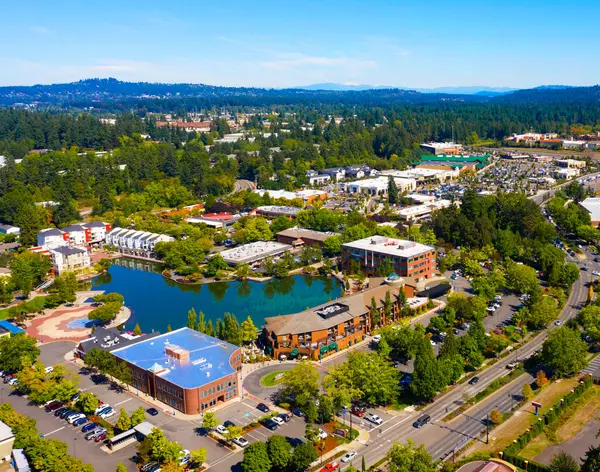
Tualatin, at a Census-estimated 28,139 residents as of July 2025, has more retail density and a wider range of employers within city limits. Office parks, light industrial space, and corporate campuses sit alongside residential neighborhoods, which is part of why the WES rail line and multiple highway interchanges exist there in the first place. Tualatin also borders the Tualatin River and has invested heavily in riverfront parks and trail connections, giving it more outdoor recreation access within a short drive of home than a strictly commercial corridor would suggest. If you want more services and more employment options without leaving city limits, Tualatin’s layout supports that. If you want a smaller, more contained daily radius, Sherwood’s does.
What This Means for You
If you are relocating and comparing these two cities, start with your actual commute pattern rather than the map distance. Pull up your real work address and test drive times at the hours you would actually be driving, because both cities’ averages hide a wide range depending on which corridor and which time of day you are using. If school boundaries matter to your decision, look up the exact address you are considering on GreatSchools.org before you commit, since Tualatin’s district assignments vary more by specific location than Sherwood’s citywide single-district setup.
On price, treat any single month’s median as a snapshot, not a forecast. Ask for a current comparative market analysis on the specific streets and school boundaries you are targeting rather than relying on citywide averages, since both cities have shown real month-to-month movement recently. And weigh the daily-life factors as much as the financial ones: a shorter commute on paper does not mean much if the daily errands, dining, and outdoor time do not fit how you actually want to live.
Jennifer Schurter serves buyers, sellers, and investors throughout South Clackamas County and the North Willamette Valley, including Canby, Oregon City, Wilsonville, Aurora, Hubbard, Molalla, Woodburn, Newberg, Sherwood, Tualatin, West Linn, Lake Oswego, and the greater Portland metro south. Her goal is simple: to be the most knowledgeable, most responsive, and most genuinely helpful real estate agent in the area, every single time. Jennifer is a licensed Oregon real estate broker with Real Broker LLC.
Ready to talk through your next move? Schedule a time with Jennifer here. No pressure, no pitch, just a real conversation.
Categories
Recent Posts









“I see my job as a Real Estate Advisor is to educate consumers about the realities of the Real Estate market of today. If you're ready to learn more about what it could mean for you to buy, sell, or invest in Real Estate, let's connect!"